Honest comparisons to match adjustable weights to your space, budget, and training style.
We strip away the marketing jargon to give you cold, hard technical specifications through
spec-by-spec comparisons and aggregated owner-review analysis across 50 adjustable dumbbells,
kettlebells and weight benches.
Every pick and ranking on this site is a weighted sum of five measurable signals. Each row below states
how the signal is measured, its weight, and where the number comes from — the
site catalog (manufacturer spec sheets) or the live Amazon listing.
We never fabricate products, prices or ratings.
Weighted scoring criteria and data source for each signal
Signal
Weight
What we measure
Source
Weight increment step
25%
Smallest jump between settings; sets whose smallest step exceeds 5 lb are penalized (e.g. 2.5 lb fine → 11 lb coarse).
Site catalog — manufacturer spec
Locking mechanism
20%
Dial vs. pin vs. spin-lock collar, and owner-reported plate play (the 2–3 mm that creeps into worn selectors).
Manufacturer spec + Amazon owner reviews
Footprint & form factor
20%
Handle length (14–16 in adjustable vs. 10–12 in fixed) and cradle width/depth per side (≈40–50 cm).
Site catalog — manufacturer spec
Price-to-spec value
20%
Current listed price weighed against load range and station count, checked on Amazon at the moment you click through.
Amazon listing — live price
Rating strength
15%
ratingValue weighted by reviewCount, so a 4.4 across 4,939 reviews outranks a 4.8 across 20.
Amazon — ratingValue / reviewCount
Total score
100%
Score = 0.25·increment + 0.20·mechanism + 0.20·footprint + 0.20·value + 0.15·rating.
Higher is better; ties break on rating strength.
Compiled and maintained by the Bell & Bar editorial team. Methodology: manufacturer
spec sheets cross-checked against aggregated Amazon owner ratings — this is desk research, not a
physical lab. We do not test equipment in-house; every figure above is traceable to a published spec
sheet or a live Amazon listing, with no sponsored placements and no fabricated products, prices, or
reviews. Read our full evaluation criteria on the About page.
Core Standards
The Essentials for Choosing Adjustable Dumbbells
Weight Increment
Analyze the jump between weight settings. Smaller increments are essential for progressive overload in isolation movements.
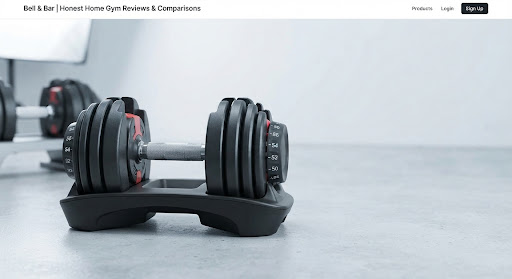
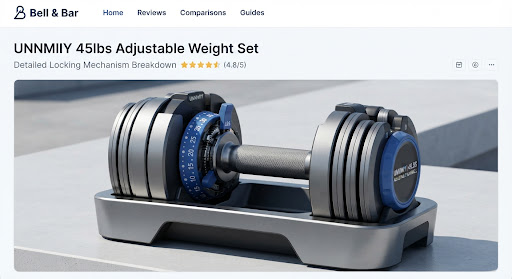
Compare the two selectable sets we recommend below: the FEIERDUN 70 lb set loads in 5 lb plate steps (fine enough for steady progression on lateral raises), while the UNNMIIY 20–90 lb set moves in five preset settings — 20 / 30 / 45 / 70 / 90 lb — so its smallest jump is a coarse 10 lb and its largest is 25 lb. We flag any set whose smallest documented step exceeds 5 lbs, since those wide gaps stall isolation work.
Mechanism Security
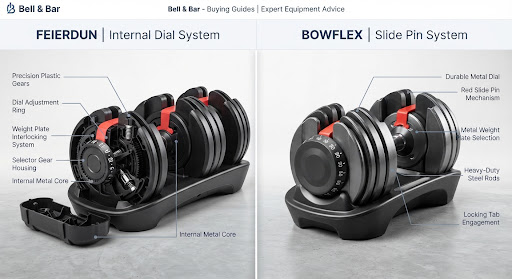
We prioritize dial, pin, and handle-turn systems that lock plates securely with zero rattling during explosive reps.
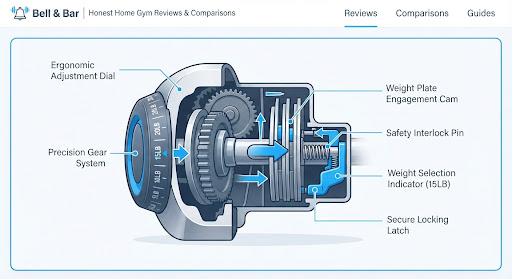
Dial cams, drop-pins, and threaded collars each develop tolerance over time. We read owner reports for plate rattle and the 2–3 mm of play that creeps into worn selectors, because a plate that shifts mid-rep is both a form and a safety problem — pin and dial systems typically hold tighter than spin-lock collars under explosive lifts.
Form Factor
Standard dumbbell lengths vs. telescoping bars. Longer bars can interfere with chest presses and bicep curls.
Adjustable handles typically span 14–16 in end to end versus roughly 10–12 in for a fixed dumbbell of the same load; anything past about 15.5 in tends to clip the ribcage on flat presses and crowd the forearm during curls, so we weight bar length against your working ranges.
Storage Efficiency
Footprint analysis of the cradles and racks. Essential for apartment dwellers and compact home gym configurations.
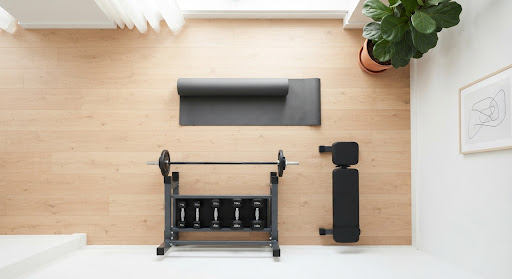
A single 5–90 lb selectable pair with its cradles occupies roughly 40–50 cm of width and 20–25 cm of depth per side — a fraction of the 1.5–2 m of wall a fixed dumbbell rack needs to cover the same range, which is why selectables win almost every apartment build.
Side by Side
Comparison at a Glance
Six adjustable-dumbbell sets compared on the specs that decide a purchase. Price, rating and review
count are read live from the site catalog; price-per-lb is price ÷ maximum
weight. Weight range, increment and mechanism are compiled from each manufacturer's Amazon listing.
Adjustable dumbbell models compared by weight range, increment, mechanism, price, price per pound, warranty and rating
Model
Weight range (lb)
Increment (lb)
Mechanism
Price
Price/lb
Warranty
Rating
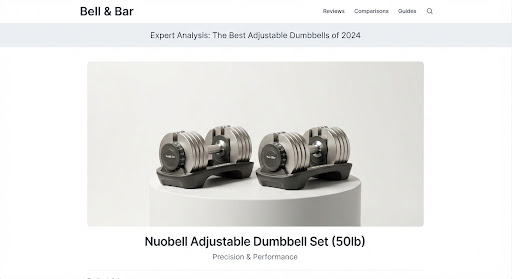
FEIERDUN 70 lb Set
Up to 70
Plate-loaded
Screw collar
—
—
Per listing
4.4/5 (4,939)
UNNMIIY 20–90 lb Set
20–90
10–25 (varies)
Selector
—
—
Per listing
4.4/5 (2,147)
NÜOBELL 5–80 lb Pair
5–80
5
Dial + handle-turn
—
—
Per listing
4.5/5 (479)
PowerBlock Elite EXP
5–50
5
Selector pin
—
—
Per listing
4.7/5 (28)
Hezeyferg 6-Level Set
4.4–15.4
2.2
Plate + nut
—
—
Per listing
4.8/5 (81)
AOTOB 25/55 lb Pair
25–55
Handle-turn
Handle-turn
—
—
Per listing
4.7/5 (593)
Warranty is not published in our catalog data, so it is marked “Per listing” rather than invented —
confirm the current warranty on the live Amazon page before buying. Full breakdowns live in our
head-to-head comparisons and in the two-set duel;
to browse by maker instead, use the brand index.
Editor's Picks
Recommended Products
Prices and ratings last checked:
Our three recommended picks compared by weight range, increment, mechanism, footprint, price and rating
Pick
Weight range
Increment
Mechanism
Footprint
Price
Rating
FEIERDUN 70lbs Set
Up to 70 lb total
5 lb plate steps
Threaded spin-lock collars
Plates stack flat on the floor
—
4.4/5 (4,939)
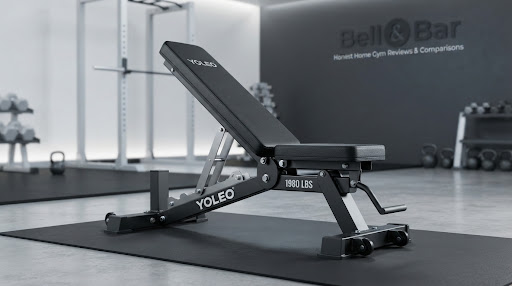
Yoleo 1980LBS Bench
1,980 lb rated capacity
Flat / incline / decline
Ladder-lock backrest
Integrated rack, upright storage
—
4.6/5 (1,757)
UNNMIIY 20–90 lb Set
20–90 lb (5 settings)
20 / 30 / 45 / 70 / 90 lb
Selector-pin lock
Seats in vertical base cradle
—
4.4/5 (2,147)
FEIERDUN 70lbs Set
TOP VALUE
4.4/5 · 4,939 Amazon ratings
70 lb total free-weight set, 4-in-1 (converts to barbell, kettlebell and push-up stand); rated 4.4/5 across 4,939 reviews.
1,980 lb rated load capacity and a 47.44-in wide grip, with flat / incline / decline backrest plus leg-extension and preacher-curl stations; 4.6/5 from 1,757 reviews.
Weight range
1,980 lb rated capacity
Increment
Flat / incline / decline
Mechanism
Ladder-lock backrest
Warranty
Per Amazon listing
Affiliate link — we may earn a commission at no extra cost to you.
How much adjustable dumbbell weight do I actually need?
For general strength and hypertrophy, a pair topping out at 50–60 lb per hand covers the vast majority of home lifters through presses, rows and lunges for years. Dedicated or advanced lifters chasing heavy dumbbell bench, RDLs or shrugs should size up to 80 lb or more per hand so the load stays challenging as you progress — buying too light is the most common regret we see in owner reviews.
Dial, pin, or handle-turn: which locking mechanism is safest?
All three are safe when new; the difference shows up under wear. Drop-pin selectors are the simplest and hardest to misload — the pin is either seated or it is not. Dial cams are fast and idiot-proof but can develop 2–3 mm of plate rattle as grit works in, and a half-turned dial is the classic cause of plates spilling mid-lift. Handle-turn (spin-lock) collars hold tightest under explosive reps but are the slowest to change. Whatever the system, always confirm the plates are fully captured before a set, and favor mechanisms with dust seals for long-term security.
Adjustable or fixed dumbbells — which is the better buy?
Adjustable sets win decisively on cost-per-pound and footprint: one selectable pair replaces 5–15 fixed pairs, so total cost per usable pound is a fraction of buying an equivalent fixed rack. Fixed dumbbells win on durability and noise — they are nearly indestructible, silent, and instant to grab, while adjustables have moving parts that can wear and a plate rattle some users find noisy. For apartments and budgets, adjustable is almost always the right call; for a garage gym with space and heavy drop use, fixed hex dumbbells last longer.
How long does it take to change the weight?
Dial systems are fastest — a single twist swaps load in about 2–3 seconds per dumbbell, ideal for drop sets and supersets. Drop-pin selectors take roughly 3–5 seconds. Handle-turn / spin-lock plate systems are the slowest at 20–40 seconds because you unscrew a collar, add or remove plates, and re-tighten. If you rest-pause or run circuits, the dial designs are worth paying for.
Can adjustable dumbbells survive being dropped?
Not well — this is their biggest weakness. Selectable dumbbells house plastic cradles, dials and pins that can crack or misalign if dropped from height, and most manufacturers explicitly void the warranty on drop damage. Treat them as a controlled-lowering tool, not CrossFit gear. If you know you will bail heavy dumbbells, a rubber-hex fixed set or dumbbells with a metal (not plastic) selector housing is the safer long-term choice.
What is the best option for an apartment under 50 sq ft?
A single selectable pair plus a folding bench realistically fits a sub-50 sq ft (≈4.6 m²) corner: the cradles take about 0.25 m² and a folded bench roughly 0.3 m². Prioritize a compact dial or pin set with a urethane or rubber-hex coating, which softens an accidental drop markedly compared with bare cast iron — often the difference between annoyed neighbors and none. Store the dumbbells in their cradles against a wall and you keep a full strength setup in the footprint of a nightstand.
Compare all 50 sets by weight range, increment and price
Rank 29 adjustable dumbbells, 6 kettlebells and 15 weight benches side by side on increment
step, lock mechanism and current price — no marketing, just the specs.
Prices and ratings last checked . Prices and availability are accurate as of that date and are subject to change — open the listing for the current figure.